
Black Policy Matters
Every major election cycle, millions of dollars in civic funding flow into get-out-the-vote (GOTV) organizations, voter mobilization drives, and community outreach coalitions. Yet, despite this massive influx of resources, the numbers on the ground tell a starkly different story: these funded groups are fundamentally failing to mobilize Black voters.
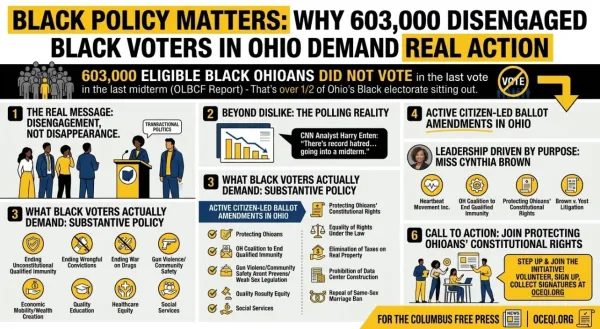
A report released by the Ohio Legislative Black Caucus Foundation revealed that over 603,000 eligible Black Ohioans did not vote in the last midterm elections. That is more than half of the state's Black electorate sitting out—a population larger than the entire city of Cleveland.
The Real Message Behind the Data
These 603,000 Black voters did not vanish or lose interest in their neighborhoods. They disengaged. For years, mainstream political organizations have treated Black communities as transactional ballot sources rather than long-term policy partners. National platforms focus heavily on high-level partisan rhetoric, yet many voters feel abandoned when decisions regarding local criminal justice, public education, housing equity, and economic mobility are made at the statehouse.
As highlighted in reporting by WOSU Public Media, the disconnect stems from candidates and campaigns failing to address the day-to-day realities of voters. When voters see policy agendas like Project 2025 advancing across the political landscape—aiming to roll back civil rights protections, undermine diversity initiatives, and alter federal oversight—the response cannot simply be a standard GOTV campaign. Black policy matters, and mobilization without a clear, protective, and empowering policy commitment yields exhaustion rather than turnout.
Beyond Dislike: The Polling Reality
While national coverage often focuses on Donald Trump's plummeting approval ratings, relying on anti-Trump sentiment alone is a failing strategy. Analyzing public polling data, CNN analyst Harry Enten noted the unprecedented depth of voter frustration: “They don't just dislike him,” Harry Enten said. “There's record hatred for the president of the United States going into a midterm.”
Yet, relying on negative sentiment against opponents is not enough to bring voters back to the polls. Disapproval does not automatically translate into turnout if voters feel neither party offers a transformative, protective vision for their communities.
What Black Voters Actually Demand
The fundamental reason traditional civic funding fails to turn out voters is a refusal to focus on substantive, high-stakes policy issues. Black voters are looking for direct action and accountability on issues that directly impact their lives, safety, and futures:
Ending Unconstitutional Qualified Immunity: Eliminating legal shields that protect police officers and public officials from accountability when violating constitutional rights.
Ending Wrongful Convictions & Systemic Reform: Reforming the justice system to overturn unjust convictions and institute true institutional oversight.
Ending the War on Drugs: Shifting away from criminalization and punitive policing toward harm reduction, public health, and restorative economic investment.
Addressing Gun Violence & Community Safety: Funding holistic, community-led violence intervention models alongside structural safety reforms.
Economic Mobility & Wealth Creation: Expanding access to capital, fair housing, workforce development, and living wages.
Quality Education & Childcare: Protecting public schools from voucher drainage and expanding early childhood education opportunities.
Healthcare Equity & Maternal Health: Eliminating disparities in healthcare access and addressing systemic biases in maternal mortality rates.
Social Services & Safety Nets: Strengthening social infrastructure, food access programs, and public assistance systems.
Active Citizen-Led Ballot Amendment Initiatives in Ohio
Ohioans can support several citizen-led ballot amendment initiatives currently active in the state petition process:
Protecting Ohioans' Constitutional Rights Initiative: Establishes a state-level civil cause of action when government actors violate constitutional rights and eliminates qualified, sovereign, and statutory immunities to hold government officials accountable.
Equality of Rights Under the Law Amendment: Guarantees equal protection and civil rights under the state constitution regardless of race, sex, age, disability, sexual orientation, or gender identity.
Abolishment/Elimination of Taxes on Real Property Initiative: Seeks to amend the Ohio Constitution to prohibit property taxes across the state.
Prohibition of Data Center Construction Amendment: Prohibits the construction of commercial data centers within the state.
Repeal of Same-Sex Marriage Ban Amendment: Repeals outdated constitutional language that restricts the legal definition of marriage to one man and one woman.
Call to Action: Join Protecting Ohioans' Constitutional Rights
Democracy does not begin or end at the ballot box or inside government halls. True democracy lives in how communities organize, build power, and create new systems to hold decision-makers accountable every single day. We must move past the cycle of short-term funding provided to groups that only show up during election windows to knock on doors. Real power requires sustained local policy work, direct community engagement, and real collective power.
We call on empathy advocates across our state to step up and join the Protecting Ohioans' Constitutional Rights citizen-led ballot amendment initiative. To support real structural reform, ensure government accountability, and help secure fundamental rights for all Ohioans, get involved today by volunteering, signing up, and collecting signatures at oceqi.org / Protecting Ohioans' Constitutional Rights.
Leadership Driven by Purpose
Following profound personal loss, Miss Cynthia Brown transformed grief into historic, systemic advocacy. As the Founder & CEO of Heartbeat Movement Inc., founder of The Ohio Coalition to End Qualified Immunity Committee, and Chair of Protecting Ohioans' Constitutional Rights, she spearheaded landmark federal civil rights litigation in Brown v. Yost, establishing vital First Amendment protections for citizen-led ballot initiative campaigns across the United States.
As a Youngstown native who majored in Media Communications, Miss Brown leads statewide nonpartisan coalitions of impacted families, advocates, and civil rights leaders dedicated to eliminating legal immunities, safeguarding fundamental constitutional liberties, and securing institutional accountability for all citizens.